
Quick Answer
A commercial extraction canopy removes heat, steam, and grease-laden vapour from a UK kitchen and is required under workplace and food hygiene law. Size the fan at roughly 1,500–3,000 m³/h per metre of canopy depending on equipment, and overhang the cooking line by 150–250mm each side. Canopies cost £495–£1,650; fans £440–£600.
Caterzone supplies commercial extraction hoods, kitchen canopies, centrifugal box fans, and grease baffle filters to UK restaurants, takeaways, kebab shops, and chicken shops, and extraction is the one specification that will stop a kitchen opening if it is wrong. Environmental Health will not sign off a cooking line without adequate extraction, and your insurer will ask about grease management after that.
This guide covers how a canopy system works, how to calculate the airflow you actually need in m³/h, canopy sizing and mounting heights, make-up air, the UK legal and insurance obligations including DW/172 and TR/19, cleaning frequency, and what it costs. Browse the extraction hood range as you read.
How does a commercial extraction system work?
A commercial extraction system has four parts, and each has to be sized to the other three or the system underperforms.
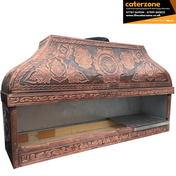
The canopy sits above the cooking line and captures the thermal plume — the column of hot air, steam, and vaporised fat rising off the equipment. Inside the canopy sit grease filters, almost always baffle filters in a UK commercial kitchen: interlocking stainless steel plates that force the airstream to change direction sharply, so grease droplets lose momentum, hit the metal, and drain into a collection channel. Mesh filters are cheaper but clog fast and are a fire risk on a heavy line.
Ductwork then carries the air to the fan and out to atmosphere. The fan itself is normally a centrifugal box fan rated in cubic metres per hour, mounted at or near the discharge so the duct run is under negative pressure — meaning any leak draws air in rather than pushing grease-laden air into the ceiling void.
The fourth part is the one people forget: make-up air. Every cubic metre you extract has to be replaced. If it is not supplied deliberately, the kitchen pulls it through doorways, under-door gaps, and — dangerously — down flues, which can cause combustion products to spill from gas equipment. Environmental Health and Gas Safe engineers both look for this.
How do you calculate the extraction rate you need?
Two methods are used in UK practice, and it is worth running both and taking the higher figure.
The canopy face velocity method works from the open area of the canopy. For a wall-mounted canopy you want roughly 0.25–0.5 m/s across the face for light cooking, rising towards 1.0 m/s for heavy grease and high-heat equipment. Multiply the canopy's open perimeter area in m² by that velocity, then by 3,600, to get m³/h.
The thermal convection method works from the equipment itself, which is why it is more reliable. Different appliances produce wildly different plumes. As a working guide per metre of canopy length:
| Equipment under the canopy | Duty | Indicative airflow per metre |
|---|---|---|
| Ovens, bain maries, boiling pans | Light | ~1,000–1,500 m³/h |
| Ranges, griddles, pasta boilers | Medium | ~1,500–2,000 m³/h |
| Fryers, salamanders, doner grills | Heavy | ~2,000–2,500 m³/h |
| Chargrills, charcoal mangals, wok ranges | Extra heavy | ~2,500–3,000+ m³/h |
A worked example: a 2-metre canopy over a six-burner range and a twin-basket fryer is medium-to-heavy duty, so 2 × roughly 2,000 m³/h gives about 4,000 m³/h. A single 3,000 m³/h fan is undersized for that line; you would specify a larger fan or split the run. Under-specification is by far the most common reason a UK installation fails inspection or leaves a kitchen unbearably hot.
How big should the canopy itself be?
The canopy must be larger than the equipment beneath it, because the thermal plume spreads as it rises. Undersized canopies spill vapour into the room no matter how powerful the fan.
Overhang the cooking line by 150–250mm on each exposed side. For a wall-mounted canopy that means the front edge and both ends; for an island canopy it means all four sides, and island canopies need more airflow because there is no wall to help contain the plume. Standard canopy depths are 1,000mm and 1,100mm, which suit most 700 and 900-series equipment lines.
Mounting height is a trade-off. Lower canopies capture better; higher canopies give staff headroom. UK practice puts the canopy lower edge at roughly 2,000–2,100mm above the finished floor, which clears most people while keeping capture effective. Every 100mm higher costs you capture efficiency and has to be paid for in extra airflow.
Specify a grease collection channel with a removable drain cup around the full perimeter, and integrated LED lighting — a dark cooking line is a safety issue and retrofitting lights into a canopy afterwards is awkward. A 1200mm deep extraction hood with motor, filters, and LED lighting at £576.90 is a typical single-appliance solution.
What does UK law require?
Extraction obligations come from several directions at once, and satisfying one does not satisfy the others.
The Workplace (Health, Safety and Welfare) Regulations 1992 require effective and suitable ventilation in every enclosed workplace, and the Management of Health and Safety at Work Regulations require you to assess and control the risk. The Food Safety and Hygiene (England) Regulations 2013 require food premises to have adequate ventilation, with mechanical ventilation where natural ventilation is insufficient — which it always is over a commercial cooking line.
Design is judged against DW/172, the BESA specification for kitchen ventilation systems, which is the document your consultant, EHO, and insurer will all reference. Cleaning is judged against BESA TR/19 Grease, which sets grease deposit thickness limits and cleaning frequencies. Most commercial insurance policies now make TR/19-compliant cleaning, with certificates and photographic evidence, a condition of cover for fire damage — so failing to clean can void a claim rather than merely risking a fine.
Gas installations add a further layer: kitchens with gas equipment under a canopy generally require an interlock that shuts off the gas supply if the extraction fan is not running, commissioned by a Gas Safe registered engineer with commercial catering qualifications. Planning permission and odour control may also apply, particularly for takeaways near residential property, where a local authority may require carbon filtration or an extended discharge stack above roof level.
How often must extraction be cleaned?
Grease filters and the full ductwork run on different schedules, and both matter.
Baffle filters should be removed and washed at least weekly, and daily in a heavy-frying or chargrill kitchen. Most are dishwasher-safe, which makes this a realistic close-down task rather than a project. A blocked filter throttles airflow, so a kitchen that suddenly feels hot and smoky has usually not developed a fan fault — it has dirty filters. Keep a spare set such as a 495x495mm stainless steel labyrinth grease baffle filter at £90.90 so the line never runs without filtration while a set is being washed.
Ductwork and the fan require professional cleaning under TR/19. Indicative frequencies are every twelve months for light use, every six months for moderate use, and every three months for heavy use — a chargrill or fryer-led kitchen sits in the heavy category. The contractor should measure grease deposit thickness, clean to the TR/19 limit, and issue a certificate with before-and-after photographs. Keep those certificates: they are what your insurer will ask for after a fire.
The reason the schedule is strict is that accumulated duct grease is fuel in an enclosed, unsprinklered space that runs the length of the building. Kitchen extract fires spread through ductwork faster than through rooms.
What does commercial extraction cost in the UK?
Equipment is the smaller part of the bill; installation is the larger one.
Wall-mounted stainless steel canopies start around £495 for a 1600mm unit and run to about £1,650 for a complete 3000mm unit with box, filters, and lighting. Deep-profile canopies for heavy equipment sit higher — a 2400mm × 1100mm deep hood with motor, filters, and LED lights is around £1,557. Centrifugal box fans run roughly £440 for a 1,400 m³/h unit to £456 for a 3,000 m³/h unit and around £594 for a higher-static 1,500 m³/h box fan. Baffle filters are £90–£150 each.
Installation, ductwork, roof or wall penetration, electrical work, and gas interlock commissioning typically cost more than the canopy and fan combined, and vary enormously with the building. A short straight duct run to an external wall is inexpensive; a long run to a roof stack through a listed building is not. Get the duct route surveyed before you commit to equipment.
The false economy to avoid is buying a canopy that fits the budget rather than the equipment. An undersized system costs the same to install, fails inspection, makes the kitchen intolerable to work in, and then has to be replaced. Specify from the equipment list, not from the price list. Browse complete units in the extraction and canopy collection.
Which kitchens need the heaviest extraction?
Three UK kitchen types consistently need more extraction than a standard restaurant line, and all three are common in the independent trade.
Charcoal grills and mangals are the most demanding. Solid fuel produces smoke and particulates as well as grease and heat, and it produces them continuously rather than only while food is on. Charcoal kitchens usually require a dedicated canopy, higher airflow at the top of the range, and often a spark arrestor and separate duct run — solid fuel should not share ductwork with gas appliances.
Wok ranges are the second. A wok burner puts out enormous heat and throws an aggressive, angled plume rather than a vertical one, so wok canopies are typically deeper and hung lower than a standard canopy. Doner and shawarma grills are the third: a vertical grill running all service produces sustained grease-laden vapour, and kebab shops are also the sites most likely to face local authority odour conditions because of their high-street residential neighbours.
For these lines, a purpose-sized unit such as a 1000mm wall-mount extraction canopy at £850 paired with a 3,000 m³/h centrifugal extractor fan at £455.90 is the starting point rather than the finished answer — check the total against the per-metre figures above.
Frequently asked questions
Is a commercial extraction hood a legal requirement in the UK?
Yes. The Workplace (Health, Safety and Welfare) Regulations 1992 require suitable ventilation in every workplace, and the Food Safety and Hygiene (England) Regulations 2013 require adequate mechanical ventilation in food premises where natural ventilation is insufficient. Environmental Health will not approve a commercial cooking line without it.
How do you size a commercial extraction fan?
Calculate from the equipment beneath the canopy, per metre of canopy length: roughly 1,000–1,500 m³/h for ovens and bain maries, 1,500–2,000 for ranges and griddles, 2,000–2,500 for fryers and doner grills, and 2,500–3,000+ for chargrills and wok ranges. A 2-metre canopy over a range and fryer needs about 4,000 m³/h.
How far should a canopy overhang the cooking equipment?
Overhang each exposed side by 150–250mm, because the thermal plume widens as it rises. Island canopies need overhang on all four sides and higher airflow, as there is no wall to contain the plume. Mount the lower edge at roughly 2,000–2,100mm above the floor.
How often should kitchen extraction be cleaned?
Wash grease baffle filters weekly, or daily in a heavy-frying or chargrill kitchen. Ductwork and fans need professional cleaning to BESA TR/19 — annually for light use, every six months for moderate, and every three months for heavy use. Keep the certificates and photographs, as insurers require them.
What is TR/19 and why does it matter?
TR/19 Grease is the BESA specification for cleaning kitchen extract systems, setting grease deposit limits and cleaning frequencies. Most UK commercial insurance policies make TR/19-compliant cleaning with documented evidence a condition of fire cover, so neglecting it can invalidate a claim rather than just risking enforcement.
Do gas kitchens need an extraction interlock?
Generally yes. Gas equipment under a canopy usually requires an interlock that isolates the gas supply if the extraction fan is not running, preventing combustion products building up in the kitchen. It must be installed and commissioned by a Gas Safe registered engineer holding commercial catering qualifications.
Where to buy commercial extraction hoods in the UK
Caterzone stocks wall-mounted and deep-profile extraction canopies from 1000mm to 3000mm, centrifugal box fans, and stainless steel grease baffle filters. Browse the extraction hoods and canopies collection, or start with the 1200mm deep extraction hood with motor, filters, and LED lighting at £576.90, pair it with a 3,000 m³/h centrifugal extractor fan at £455.90, and keep spare grease baffle filters at £90.90 so the line never runs unfiltered.
For the heavy-duty cooking lines that drive extraction sizing, read our Turkish BBQ, charcoal grill and mangal guide and our commercial wok cooker and Chinese range guide. To size a canopy and fan against your equipment list, call Caterzone on +44 1604 969239 or email info@thecaterzone.co.uk.