
Quick Answer
A peri peri chicken steamer par-cooks whole or spatchcocked chickens in saturated steam at 100°C in 20–30 minutes, leaving only 4–6 minutes on the chargrill to order. A 2/1 GN atmospheric steamer holds 8–12 birds per load, roughly 25–35 per hour. UK poultry must reach 75°C at the core.
Caterzone supplies peri peri chicken steamers and commercial steam ovens to flame-grilled chicken shops across the UK, and this is the single piece of equipment that makes the format work. Without a steamer, a whole chicken takes 45 minutes from raw on a chargrill and no customer waits that long. With one, the bird is already cooked through and the grill becomes a finishing station rather than a bottleneck.
This guide covers how chicken steamers work, atmospheric versus pressure steaming, realistic hourly output, water treatment, UK food safety requirements, and running costs — everything you need to specify the right commercial steamer or steam oven.
What is a chicken steamer used for?
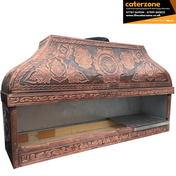
A commercial chicken steamer is an atmospheric steam oven that par-cooks poultry with saturated steam at around 100°C before it is finished on a chargrill or in a hot-hold. UK peri peri and Portuguese-style chicken shops use it because a whole spatchcocked chicken cooks through in 20–30 minutes and stays genuinely moist, since steam transfers heat efficiently without drying the surface the way dry radiant heat does.
The operational effect is what matters. Par-cooked birds are held chilled or hot, and when an order lands the chicken goes onto the grill for 4–6 minutes to take on char, colour, and marinade. Ticket times drop from three quarters of an hour to under ten minutes, one grill serves several times the covers it otherwise could, and yield improves because steamed chicken loses far less weight than chicken roasted from raw. That last point is easy to overlook and directly affects food cost.
Atmospheric or pressure steamer — which do you need?
An atmospheric steamer runs at ambient pressure and 100°C. The door can be opened mid-cycle to check or add product, the machine is mechanically simpler, it costs less, and it is the standard choice for chicken. A pressure steamer runs above atmospheric pressure at 105–120°C and cooks measurably faster, but the door locks for the duration of the cycle and there is more to go wrong and more to service.
For poultry, atmospheric is almost always correct. The time saved by pressure steaming is small relative to a 20–30 minute cycle, and the inability to open the door mid-batch is a real nuisance in a kitchen where the pace changes minute to minute. Pressure steamers earn their place in high-volume vegetable and rice production, where cycles are short and batching is predictable. A machine such as the refurbished Falcon atmospheric steamer oven is the typical peri peri shop specification.
How many chickens can a commercial steamer cook per hour?
A 2/1 GN atmospheric steamer typically holds 8–12 spatchcocked chickens per load on a 20–25 minute cycle, which gives roughly 25–35 birds per hour once you allow for loading and unloading. High-speed three-tray units such as the Hobart Bonnet 305GB high-speed steamer cook faster and suit sites pushing serious volume.
Size against your busiest hour plus about a third for headroom, not your daily average. A shop selling 200 chickens on a Saturday does not sell them evenly across ten hours; if 80 of them go between 6pm and 8pm, you need 40 birds an hour of real capacity, and a single 8-bird unit on a 25-minute cycle delivers under 20. Two smaller steamers frequently beat one large one, because they let you stagger batches and keep serving when one is being descaled.
Chicken steamer options compared
| Type | Capacity | Cycle | Birds/hour | UK price | Best for |
|---|---|---|---|---|---|
| Countertop 1/1 GN electric | 4–6 birds | 20–25 min | 10–15 | £600–£1,200 | Small takeaways, side menu |
| 2/1 GN atmospheric electric | 8–12 birds | 20–25 min | 25–35 | £1,400–£2,200 | Standard peri peri shop |
| Gas atmospheric steamer | 8–12 birds | 20–25 min | 25–35 | £800–£1,800 | Sites with gas, lower running cost |
| 3 × 1/1 GN high-speed | 12–18 birds | 15–20 min | 40–55 | £3,500–£6,000 | High-volume operations |
| Combi oven (steam mode) | Varies | 25–35 min | 20–40 | £4,000–£15,000 | Kitchens needing multi-function |
Does a chicken steamer need a water filter?
Yes, and this is the most expensive lesson operators learn the hard way. A steamer boils water continuously through service. UK mains water averages around 243 ppm hardness, and in the hard-water belt across the south and east it runs considerably higher. Every litre boiled deposits its dissolved calcium inside the boiler and onto the elements, and within months output drops, cycles lengthen, and elements burn out.
Fit a water softener or scale-reduction filter from the day of installation. Most manufacturers make water treatment an explicit warranty condition, so skipping it does not save money — it transfers a £300 filter cost into a £900 element replacement that you pay for yourself. Descale on the manufacturer's schedule, keep the record, and change filter cartridges on time. In a hard-water area, budget for cartridge changes every three to six months depending on throughput.
What core temperature must steamed chicken reach in the UK?
UK food safety guidance requires poultry to reach 75°C at the core, or an equivalent time-temperature combination such as 70°C held for two minutes. Probe the thickest part of the thigh — not the breast — on every batch, and log the reading. This is a standard EHO checkpoint and a documented log is what turns a good process into a defensible one at inspection.
The chilling step is where par-cooking operations most often fall down. Chicken that is not going straight into hot holding must be cooled below 8°C, and the accepted practice is to get it there within 90 minutes. Racking birds on a counter to cool slowly sits them in the 8–63°C danger zone for hours and is exactly what an EHO looks for in a chicken shop. Use a blast chiller if volume justifies it, or plan batch sizes so par-cooked stock goes to hot holding at or above 63°C rather than cooling at all.
Hot holding must be at 63°C or above. If you hold below that, UK regulations allow a single period of up to two hours before the food must be used, chilled, or discarded — and you need to be able to show which. Under HACCP, steaming, chilling, and holding are each critical control points with their own records.
Gas or electric steamer, and what does it cost to run?
Gas steamers cost less to run — roughly 7–10p/kWh against about 28p/kWh for commercial electricity — which is significant on a machine boiling water for ten hours a day. A gas unit such as the refurbished Moorwood natural gas steamer oven can pay back its installation cost within a year or two on a busy site. Against that, gas requires a Gas Safe registered engineer for installation and annual servicing, plus a gas interlock tied to your extraction canopy.
Electric steamers install far more simply and control temperature precisely, though larger units frequently need a three-phase supply — check before ordering. A refurbished Lincat 2/1 electric steamer is a common choice for sites without gas. On energy, a 12kW electric steamer at roughly 50% duty over 10 hours uses about 60kWh, or £17 a day, around £5,000 a year. The same duty on gas costs closer to £1,800. Refurbished units are strong value in this category because the boiler, chamber, and stainless bodywork are simple, long-lived components.
Frequently asked questions
What is a chicken steamer used for?
A commercial chicken steamer par-cooks whole or spatchcocked chickens with saturated steam at around 100°C before they are finished on a chargrill. A whole chicken cooks through in 20–30 minutes and stays moist, leaving only 4–6 minutes of grilling to order rather than 45 minutes from raw.
How many chickens can a commercial steamer cook per hour?
A 2/1 GN atmospheric steamer typically holds 8–12 spatchcocked chickens per load on a 20–25 minute cycle, giving roughly 25–35 birds per hour. High-speed three-tray units cook faster. Size against your busiest hour plus about a third for headroom, not your daily average.
What is the difference between an atmospheric steamer and a pressure steamer?
An atmospheric steamer runs at ambient pressure and 100°C, so the door opens mid-cycle — simpler, cheaper, and standard for chicken. A pressure steamer runs at 105–120°C and cooks faster, but the door locks during the cycle and it needs more maintenance. Pressure steamers suit vegetable and rice production.
Does a chicken steamer need a water filter?
Yes. A steamer boils water continuously and UK water averages 243 ppm hardness, so limescale will cut output and burn out elements within months in a hard-water area. Fit a softener or scale-reduction filter from installation — most manufacturers make it a warranty condition — and descale on schedule.
What core temperature must steamed chicken reach in the UK?
UK guidance requires poultry to reach 75°C at the core, or an equivalent such as 70°C held for two minutes. Probe the thickest part of the thigh on every batch and log the reading. Par-cooked chicken not going straight to hot holding must be chilled below 8°C within 90 minutes.
Where to buy chicken steamers in the UK
Caterzone stocks commercial steamers and steam ovens suited to peri peri and flame-grilled chicken operations, including refurbished units from Falcon, Lincat, Moorwood, and Hobart. Browse the commercial oven and steamer collection, or look at the Falcon electric atmospheric steamer for a standard shop, the Moorwood gas steamer where running cost matters most, or the Hobart Bonnet high-speed steamer for high volume.
If you are weighing a steamer against a multi-function oven, read our comparison of convection ovens versus combi ovens, and our commercial gas range cooker guide for the rest of the cook line. For advice on sizing a steamer to your peak hour, call Caterzone on +44 7787 069044 or email info@thecaterzone.co.uk.
Looking to buy? Shop our range
Browse Commercial Ovens & Steamers at Caterzone — UK trade prices, fast delivery, and expert support. Call +44 7787 069044 or email info@thecaterzone.co.uk.